No Hope if Trump Wins Again

Leaving Washington, D.C., behind, the Trumps lath Air Force 1 at Joint Base Andrews in Maryland on Jan. xx, hours earlier President Biden's inauguration. Pete Marovich/Pool/Getty Images hide caption
toggle explanation
Pete Marovich/Pool/Getty Images
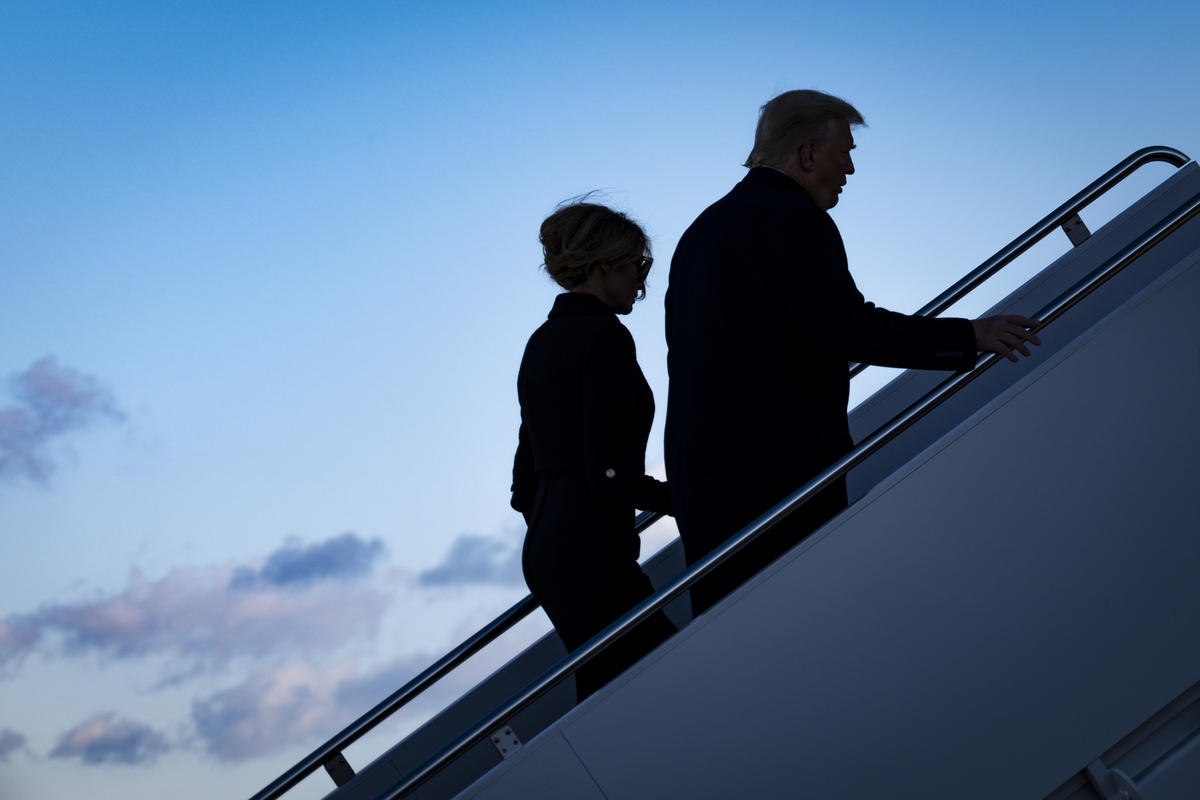
Leaving Washington, D.C., backside, the Trumps lath Air Force One at Articulation Base Andrews in Maryland on Jan. 20, hours earlier President Biden's inauguration.
Pete Marovich/Pool/Getty Images
The Senate had a test vote this calendar week that cast deep doubtfulness on the prospects for convicting former President Donald Trump on the impeachment charge now pending against him. Without a 2-thirds majority for conviction, there volition not be a second vote in the Senate to bar him from time to come federal office.
Also this calendar week, Politico released a Morning Consult poll that establish 56% of Republicans proverb that Trump should run once again in 2024. Equally he left Washington, D.C., on January. 20, he said he expected to be "back in some course."
So volition he seek a comeback? And if he does, what are his chances of returning to the White Firm?
History provides little guidance on these questions. There is little precedent for a quondam president running again, allow alone winning. Just since when has the lack of precedent bothered Donald Trump?
Only one president who was defeated for reelection has come up back to win over again. That was Grover Cleveland, beginning elected in 1884, narrowly defeated in 1888 and elected over again in 1892.
Another, far better-known president, Theodore Roosevelt, left office voluntarily in 1908, assertive his hand-picked successor, William Howard Taft, would continue his policies. When Taft did non, Roosevelt came back to run against him iv years later.
The Republican Party establishment of that time stood past Taft, the incumbent, then Roosevelt ran as a third-political party candidate. That split the Republican vote and handed the presidency to Democrat Woodrow Wilson.
And that's it. Aside from those 2 men, no defeated White House occupant has come up dorsum to claim votes in the Electoral Higher. Autonomous President Martin Van Buren, defeated for reelection in 1840, sought his party's nomination in 1844 and 1848 only was denied it both times. The latter fourth dimension he helped institute the anti-slavery Free Soil Political party and ran as its nominee, getting x% of the popular vote but winning no states.
More than than a few former presidents may accept been ready to leave public life by the end of their time at the acme. Others surely would have liked to stay longer, only they were sent packing, either by voters in November or by the nominating appliance of their parties.
There have too been viii presidents who have died in office. 4 in the 1800s (William Harrison, Zachary Taylor, Abraham Lincoln and James Garfield) were succeeded by lackluster vice presidents who were not nominated for a term on their own. Four in the 1900s (William McKinley, Warren Harding, Franklin D. Roosevelt and John F. Kennedy) were succeeded by vice presidents whose parties did nominate them for a term in their ain right (Theodore Roosevelt, Calvin Coolidge, Harry Truman and Lyndon Johnson).
Each of these 4 went on to win a term on his ain, and each then left role voluntarily. As noted above, Theodore Roosevelt later changed his mind, and Johnson began the 1968 primary season as an incumbent and a candidate only ended his run at the end of March.
The Jackson model

A statue of President Andrew Jackson in Lafayette Square near the White Firm in June. Mandel Ngan/AFP via Getty Images hibernate caption
toggle caption
Mandel Ngan/AFP via Getty Images
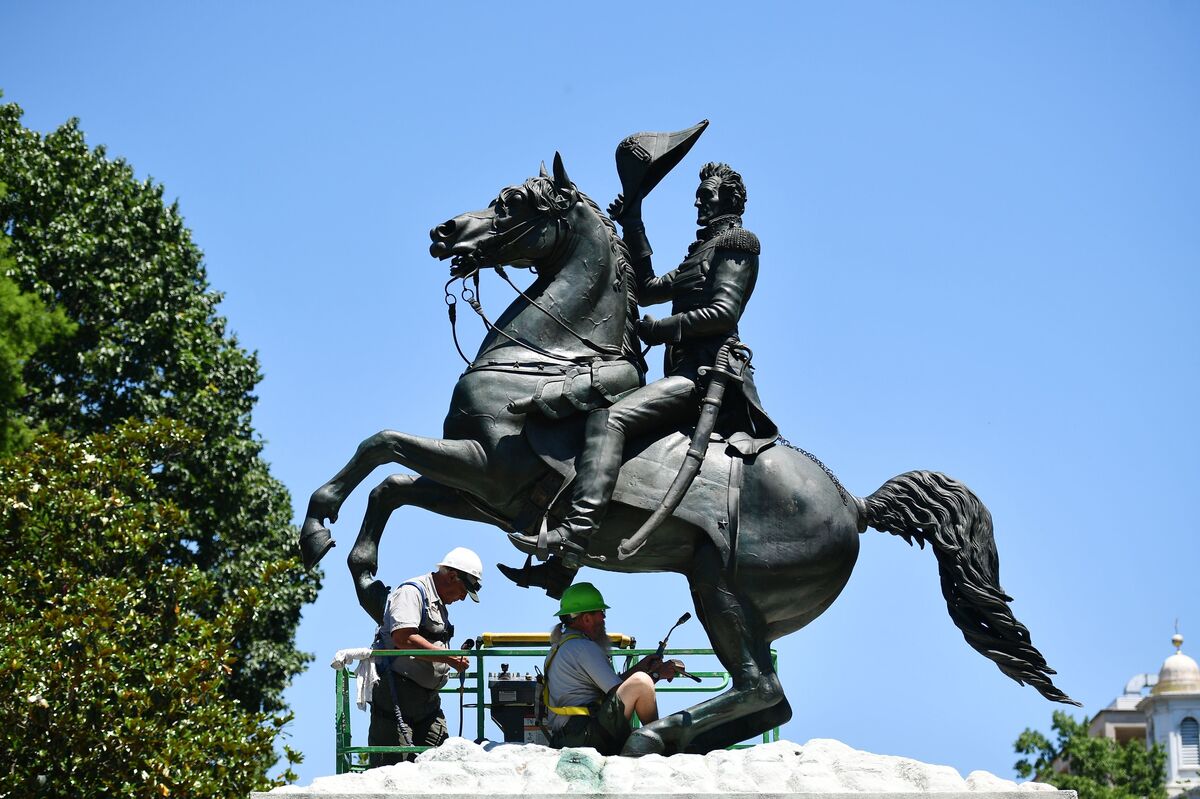
A statue of President Andrew Jackson in Lafayette Square near the White Business firm in June.
Mandel Ngan/AFP via Getty Images
One model that might exist meaningful for Trump at this stage is that of President Andrew Jackson, who ran for president three times and arguably won each time. His first entrada, in 1824, was a iv-way competition in which he clearly led in both the popular vote and the Balloter College but lacked the needed majority in the latter.
That sent the effect to the House of Representatives, where each state had one vote. A protracted and dubious negotiation involving candidates and congressional power brokers after denied Jackson the prize. He immediately denounced that result as a "corrupt bargain," laying the groundwork for another bid. In 1828, Jackson was swept into office, ousting the incumbent on a wave of populist fervor.
It is non an accident that Trump, post-obit the advice of sometime adviser Steve Bannon, spoke agreeably of Jackson in 2016. When he entered the White House, Trump hung Jackson's presidential portrait in the Oval Office overlooking the Resolute Desk.
It is non hard to imagine Trump invoking the spirit of Jackson'southward 1828 campaign against the "corrupt bargain," if he runs in 2024 against "the steal" (his shorthand for the result of the 2020 election, which he falsely claims was illegitimate).
Jackson, the ultimate outsider in his own time, makes a far better template for Trump than either Cleveland or Teddy Roosevelt — even though the latter two were New Yorkers like Trump.
Ii New York governors, two decades apart
For now, Cleveland remains the only two-term president who had a time out between terms. When he first won in 1884, he was the first Democratic president elected in 28 years, and he won by the micro-margin of just 25,000 votes nationwide. He won because he carried New York, where he was governor at the fourth dimension, adding its balloter votes to those of Democratic-leaning states in the South – which preferred a Democratic Yankee to a Republican Yankee.
The latter, James Blaine of Maine, was widely known as "Slippery Jim," and his reputation made him repugnant to the more reform-minded members of his own party. Blaine was also faulted in that campaign for declining to renounce a zealous supporter who had called Democrats the political party of "rum, Romanism and rebellion." That phrase, which has lived on in infamy, was a derogatory reference to Democrats' "wet" sentiments on the consequence of alcohol also every bit to the Roman Catholics and former secessionists to be found in the political party tent.
Potent equally information technology was, that language backfired by alienating enough Catholics in New York to elect Cleveland, himself a Protestant. His margin in his home land was a mere g votes, merely it was enough to deliver a majority in the Electoral College.
After Cleveland's first term, the election was excruciatingly shut again. The salient effect of 1888 was the tariff on goods from foreign countries. Republicans were for it, making an argument not unlike Trump's ain America Outset rhetoric of 2016. Cleveland, on the other hand, said the tariff enriched big business organisation merely hurt consumers. He won the national popular vote but not the Electoral College, having fallen xv,000 votes short in his home state of New York.
Merely Cleveland scarcely broke pace. He continued to campaign over the ensuing years and easily won the Democratic nomination for the 3rd consecutive time in 1892. He then dismissed the one-term incumbent to whom he had lost in 1888, Benjamin Harrison, who received less than a third of the Electoral Higher vote.

A statue of Theodore Roosevelt in New York City. Later leaving part, Roosevelt tried unsuccessfully to render to the White House. David Dee Delgado/Getty Images hide caption
toggle caption
David Dee Delgado/Getty Images

A statue of Theodore Roosevelt in New York City. After leaving function, Roosevelt tried unsuccessfully to render to the White House.
David Dee Delgado/Getty Images
Cleveland stepped downwardly after his second term, as other reelected presidents had seen fit to exercise in emulation of George Washington. The Republicans reclaimed the presidency with William McKinley in 1896 and four years after renominated him with a new running mate who brought youth and vigor to the ticket. Just 41 at the time, Theodore Roosevelt had notwithstanding been a police commissioner, a "Rough Passenger" cavalry officer in the Spanish-American War and governor of New York.
Less than a year into that term, McKinley was fatally shot, making Roosevelt president at historic period 42 (still the record for youngest chief executive). He won a term of his ain in 1904 and promptly pledged non to run again. True to his word, in 1908 he handed off to his hand-picked successor, Taft.
Roosevelt did and then believing Taft would continue his policies. But if Roosevelt had managed to observe entreatment as both a populist figure and a progressive, Taft more oftentimes stood with the political party's business-oriented regulars. So "T.R." decided to challenge Taft for the Republican nomination in 1912.
He did well in the nascent "primary elections" held that year, simply Taft had the party machinery and controlled the convention. Roosevelt led his delegates out of the convention and organized a third party, the Progressive Party (known colloquially equally the "Balderdash Moose" party).
That fall, Roosevelt had his revenge on Taft and the GOP. The incumbent Taft finished a poor third with merely eight votes in the Balloter Higher. Only Roosevelt was not the primary beneficiary, finishing a afar 2nd to Wilson, the Democrat, who had 435 electoral votes to Roosevelt's 88. Although the ii Republican rivals' combined popular vote would have easily bested Wilson, dividing the party left them both in his wake.
A warning to the GOP?
That is the model some Republicans may fear seeing played out in 2024. If nominated, Trump would need to replicate Cleveland'southward unique feat from the 1890s, and he would need to overcome the demographics and voter trends that have enabled Democrats to win the popular vote in vii of the last eight presidential cycles.
And if he is non nominated, Trump running every bit an independent or as the nominee of a tertiary party would surely split the Republican vote and make a repeat of 1912 highly likely.
Nonetheless, the grip Trump has on one-half or more than of the GOP voter base makes him not only formidable only unavoidable every bit the party plans for the midterm elections in 2022 and the ultimate question of a nominee in 2024.
To exist clear, Trump has non said he will run again in 2024. On the day he left Washington he spoke of a return "in some grade" but was vague almost how that might happen. He has sent aides to discourage talk of his forming a third party.
For the time being, at least, Trump seems intent on wielding influence in the Republican Political party he has dominated for the by five years — making it articulate he will exist involved in primaries in 2022 confronting Republicans who did not support his campaign to overturn the election results.
That is no idle threat. Well-nigh Trump supporters have shown remarkable loyalty throughout the mail-election traumas, even afterwards the riot in the U.S. Capitol. The fierceness of that attachment has sobered those in the GOP who had thought Trump's era would wane afterward he was defeated. But Trump has been able to agree the pop imagination within his political party, largely by convincing many that he was non defeated.
The results of the election have been certified in all fifty states by governors and state officials of both parties, and there is no evidence for any of the conspiracy theories questioning their validity. Still, multiple polls take shown Trump supporters keep to believe he was unjustly removed from office.
Assuming Trump is not bedevilled on his impeachment charge of inciting an insurrection earlier the Jan. 6 invasion of the Capitol, he will not face a ban on future campaigns.
Some believe Trump might still be kept out of federal office by an invocation of the 14th Amendment. That part of the Constitution, added later the Ceremonious State of war with former Amalgamated officers in mind, banned any who had "engaged in insurrection" against the government.
But that wording could well exist read to require activity against the authorities, not just incitement of others to action by incendiary speech. It could also require lengthy litigation in federal courts and a balancing of the 14th Subpoena with the free speech protections of the Showtime Subpoena.
All that can be said at this betoken is that the former president will settle into a post-presidential routine far from his previous homes in Washington and New York City. And the greatest obstacle to his return to power would seem to be the design of history regarding the post-presidential careers of his predecessors.
Source: https://www.npr.org/2021/01/30/961919674/could-trump-make-a-comeback-in-2024
0 Response to "No Hope if Trump Wins Again"
Post a Comment